
IBAM EP81: The 7 IBAM Loan Fund Principles That Protect Kingdom Capital for the Long Term, Series 1

“If I’m working with someone with poor character, I’m going to lose money every time.”
— Steve Adams | IBAM
Why small loans, strong character, and patient growth are essential for sustainable Business as Mission
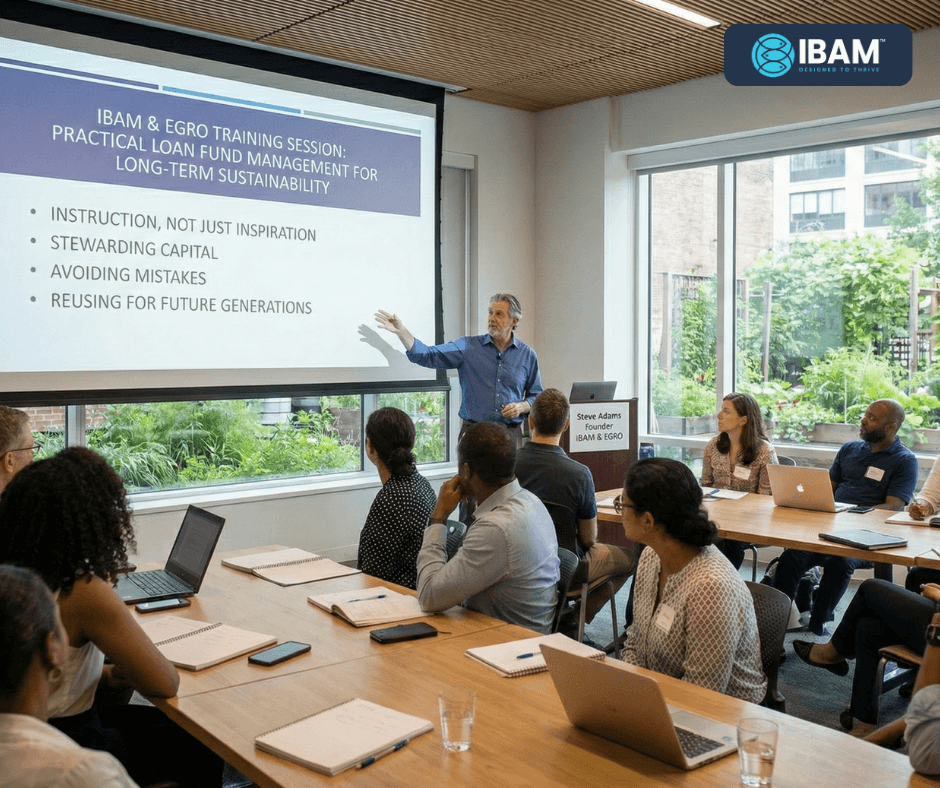
This article is based entirely on a training session led by Steve Adams, Founder of IBAM and EGRO, created specifically for IBAM partners managing local loan funds. The purpose of this teaching is not inspiration alone—it is practical instruction designed to help partners manage loan funds more effectively, more efficiently, and with long-term sustainability in mind.
Steve shares lessons drawn from his early career as a corporate banker and loan officer in the United States, combined with more than two decades of experience working in international microcredit and Business as Mission. His goal is clear: help partners avoid repeating costly mistakes and instead steward capital in a way that allows it to be reused again and again for future generations of entrepreneurs.
This is not a fast-growth model. It is a quality-driven, long-term approach rooted in discipline, process, and stewardship.
Why IBAM Exists and How the Partnership Model Works
IBAM was founded with the goal of coming alongside local partners to help accelerate their vision to reach people for Christ—through business.
The original idea was simple but intentional:
Help individual believers and families start or expand businesses
Teach them how to do business God’s way
Equip them with a Kingdom vision that serves more than personal gain
Over time, this approach evolved into a clear partnership model:
IBAM raises donor funds globally
Those funds are granted (not loaned) into local partner organizations
Each partner manages a separate local loan fund
Loans are made locally, repaid locally, and recycled locally
This structure increases accountability and repayment because borrowers perceive the funds as coming from their own community rather than from abroad.
IBAM’s long-term role is not control—it is consultation, training, and support, helping partners steward funds well so they can continue empowering new generations of entrepreneurs.
The Core Problem IBAM Is Solving
One of the key challenges Steve identifies is over-dependence on donations.
Donations are not bad, and they are not going away. But when ministries rely exclusively on donations, the work often suffers when funding declines. IBAM’s model is designed to work alongside donations, providing a stabilizing economic platform that strengthens families, churches, and disciple-making movements.
Business ownership also provides believers—especially in challenging cultural or religious environments—with a way to engage their communities, regain dignity, and regain opportunity when traditional employment is lost.
How IBAM Loan Funds Are Structured
The loan fund structure follows a consistent pattern:
Donor funds raised through IBAM are granted to local partners
Funds are placed into a dedicated loan fund account
Loans are approved locally and disbursed locally
As loans are repaid, funds are recycled to new entrepreneurs
Borrowers are reminded that repayment is not just obligation—it is paying it forward so others can step into their God-given calling as well.
The 7 Principles That Guide IBAM Loan Funds
Principle #1: Make Many Small Loans, Not a Few Large Ones
IBAM intentionally limits loan size, often at a maximum of $1,000 USD.
Why?
Spreading $10,000 across 10–15 entrepreneurs reduces risk
Losing one small loan is survivable; losing a large one is not
Small loans allow more people to participate
IBAM also emphasizes that businesses can be started with limited capital, particularly outside the U.S., where costs are generally lower.
Principle #2: Only Loan to Service-Based Businesses
IBAM does not loan money to product-based businesses such as:
Stores
Cafés
Restaurants
Manufacturing startups
These businesses have a high failure rate.
Instead, IBAM focuses exclusively on service businesses, such as:
Repair services
Cleaning services
Skilled trades
Professional services
Service businesses:
Require minimal capital
Depend more on personal character and effort
Put entrepreneurs directly in front of people
Consistently demonstrate higher repayment rates
Principle #3: Only Loan to People of Demonstrated Godly Character
Legal contracts cannot compensate for poor character.
Steve explains that no matter how strong agreements are, lending to someone without integrity almost always results in loss. IBAM therefore requires that borrowers:
Are known personally by leadership
Have demonstrated faithfulness over time
Show evidence of life change after coming to faith
Past failure does not disqualify someone—but time and trajectory matter.
Principle #4: Shorter Repayment Periods Reduce Risk
IBAM strongly prefers loans with repayment periods of one to two years, never exceeding three.
Loan fees (not interest) are structured by duration:
1 year: 10% fee
2 years: 20% fee
3 years: 30% fee
Longer loans increase risk and were consistently linked to failures in the past—especially with product-based businesses.
Principle #5: Monthly Financial Reporting Is Required
IBAM’s model works best in urban or semi-urban environments where:
Entrepreneurs can maintain records
Monthly reports can be submitted
Financial data is logged consistently
Monthly reporting creates accountability and allows entrepreneurs to make small adjustments before problems become crises.
If reporting cannot happen, the model should not be used.
Principle #6: Be Proactive When Problems Arise
When borrowers struggle, they often hide. IBAM encourages the opposite approach:
Early conversations
Honest dialogue
Supportive intervention
Most business problems are common and solvable. Early coaching shortens the learning curve and protects the loan fund.
Principle #7: Concentrate Before Expanding
IBAM advises partners to:
Focus on one geographic area first
Build experience and success stories
Develop strong loan committees and trainers
Expand only after proven results
Rapid growth creates fragility. Sustainable growth requires patience.
Why Speed Is the Enemy of Sustainability
Steve emphasizes that loan funds are not a “speed ministry.”
Training can happen quickly
Lending cannot
If loan funds fail too often, donor trust erodes and future funding becomes impossible. Integrity with donors requires disciplined stewardship and high repayment rates.
This is a long-game strategy, compared to planting trees that may not bear fruit for decades.
Final Encouragement to Partners
IBAM’s process was refined over 20 years and is designed to work when followed faithfully. Success depends on:
Following the system
Training trainers thoroughly
Maintaining accountability
Thinking generationally
This approach is not flashy—but it is sustainable.
👉 Watch the full episode here: https://youtu.be/VziCSeUMrGg
👉 Join the mission: https://www.ibam.org
This blog post is written exclusively from the EP 81 transcript featuring Steve Adams. All principles, explanations, examples, and language are derived directly from the spoken content without added interpretation or external sources.
Become an Impact Partner...


Share and Comment...

Real-World Stories of Business as Missions
Tune in to the International Business as Mission podcast, where faith and entrepreneurship intersect. Each week, gain insights from industry leaders and experts on building companies that glorify God while making a difference globally.


Download Your FREE Resources Below


Contact Us
Email: hello@ibam.org
Telephone: +1 (703) 652-iBAM (4226)
Join the IBAM™ Movement
Participate in projects that balance profit with purpose!
Mailing Address
PO Box 4323
Wheaton, Il 60189, USA
See What IBAM Is Up To On Social!


© 2026 IBAM™ All Rights Reserved.