
IBAM EP 98: Faith and Work: How Christian Leaders Stay Grounded When Success Demands More

“The perfect work-life balance isn’t really sustainable to flat line.” — Jim Batten
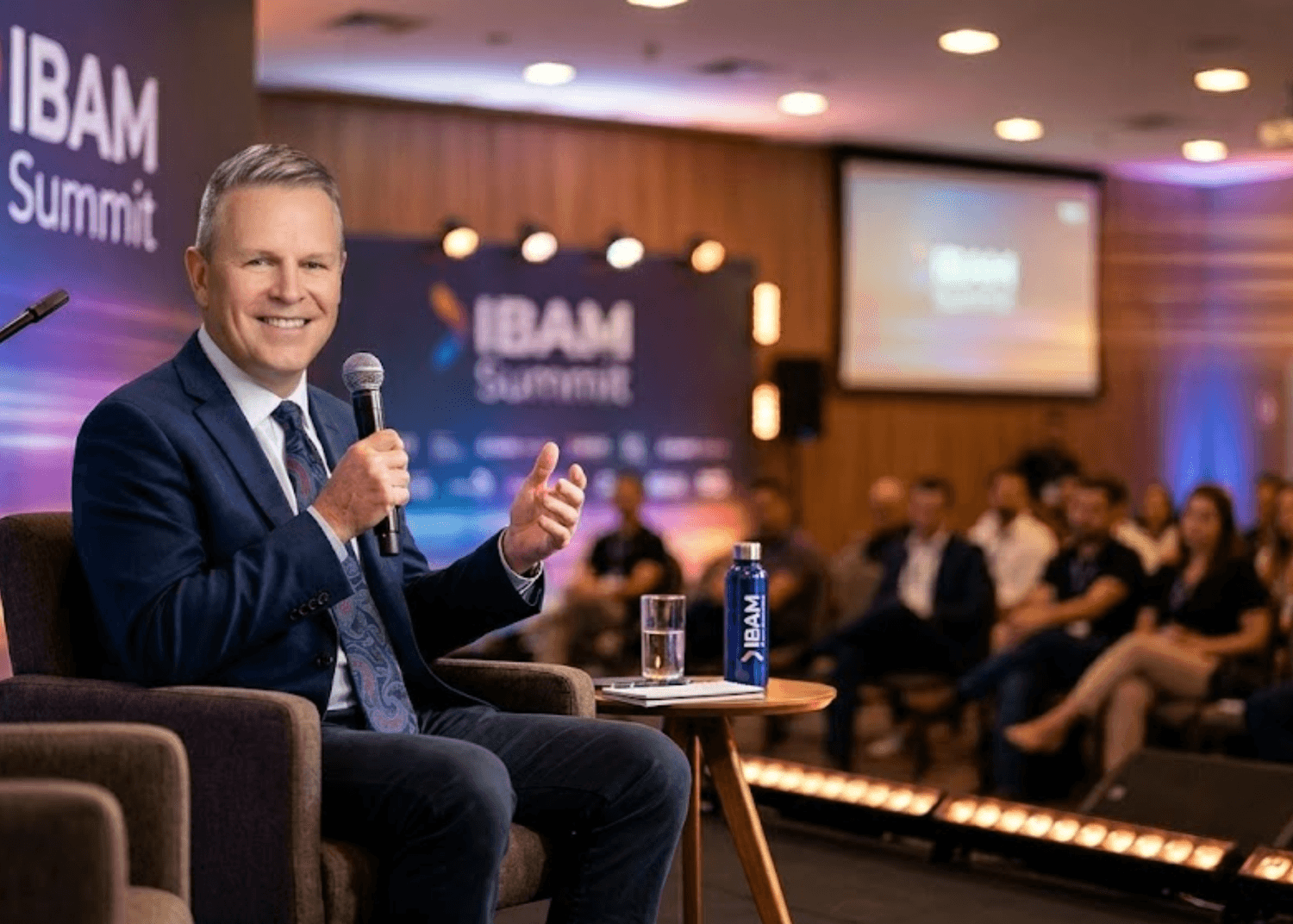
In this IBAM Summit conversation, Jim Batten shares practical wisdom on leadership, family, and spiritual discipline.
There are conversations about leadership that stay on the surface.
Titles. Companies. Career milestones. Revenue growth. Board roles. Public companies. Banking. Expansion. Strategy.
And then there are conversations that go a layer deeper.
This IBAM Summit conversation with Steve Adams and Jim Batten is the second kind.
Yes, Jim’s background is impressive. Steve introduces him as someone who has served in significant business, banking, board, and community roles. Jim has served with QCR Holdings, Guaranty Bank, H2D2 LLC, International Dehydrated Foods, and O’Reilly Automotive. He has also served on multiple community and organizational boards.
But the heart of this conversation is not simply about what Jim has done.
It is about how he has tried to carry responsibility as a Christ follower.
It is about faith and work.
It is about family and calling.
It is about the pressure of leadership, the limits of personal capacity, and the quiet decisions that help a leader stay grounded when work demands more than usual.
And tucked inside the conversation is one simple picture every leader should sit with:
Who is holding the rock?
A Conversation That Begins With Family
Before Steve and Jim get deep into business, banking, and leadership, Steve starts somewhere simple and deeply human.
Family.
Jim says that is a fitting place to begin because, after his faith, family is number one in his life. He talks about his wife, Lorna, their 40 years of marriage, their five children, their sons and daughters, their grandchildren, and the blessing of family life.
That opening matters.
Because for all the leadership experience Jim brings to the table, the conversation does not begin with a résumé.
It begins with what is closest to home.
Jim also shares that one of his daughters was originally from Haiti and was adopted into their family nearly 12 years ago. Another daughter is living in Boston and helping plant a church there. Most of the family is still in Missouri, with one grandchild a couple of hours away in Columbia.
There is a warmth in this part of the conversation. Steve even jokes about living across the street from his grandkids and how nobody told him how great that would be.
It is light. It is personal. It is real.
And it sets the tone for the rest of the episode.
Before we talk about success, we need to talk about what success is supposed to serve.
Faith as the Foundation
Steve then asks Jim how he came to know the Lord.
Jim’s answer is rooted in family history. His parents had been in church as children, but later were not involved in church. While Jim’s mother was pregnant with him, someone invited them to a revival meeting. They went, and during that revival, they rededicated their lives to the Lord.
Because of that, Jim says he was raised in church his whole life.
He came to the Lord as a child, had moments along the way where he was “not doing so hot,” and then, as an adult, has been faithfully serving God for a number of years.
Then Jim says something that reveals a lot about how he measures life:
His kids are all serving God, and in his mind, that is the number one measure of success.
Not mentioned in transcript: a step-by-step parenting formula.
In fact, Steve is careful here. He acknowledges that he knows godly people who seemingly did everything right, and their children made different choices. He does not turn this into a simplistic equation.
Jim agrees. At the end of the day, he says you cannot take credit for it. It is the Lord.
That is an important distinction.
This is not a conversation about control.
It is a conversation about faithfulness.
The Weight of Business Responsibility
After family and faith, Steve moves into Jim’s current and past roles.
Jim talks about the bank holding company structure, community banking, local decision-making, and why maintaining local charters and local names matters. He describes the model as “super community,” with four bank charters and a strong community focus.
The conversation gets specific.
They discuss:
Community banking
Local decision-making
Bank charters
Holding company structure
Internal participation
Mergers and acquisitions
Compliance
Public market challenges
Culture preservation during acquisition
Jim explains that Guaranty Bank was independent and publicly traded, but was having difficulty getting to the next level. The bank explored options, looked at mergers of equals, and ultimately found QCR Holdings. One of the positives, as Jim describes it, was being able to keep virtually all team members and maintain much of the culture.
Steve recognizes the value of that, especially compared to situations where a buyer comes in, changes the signs, cuts local staff, and disrupts the culture.
This portion of the conversation matters because it shows something important about leadership:
Business decisions are rarely just financial.
They affect people.
They affect teams.
They affect culture.
They affect communities.
Jim’s leadership experience was not theoretical. He had lived inside environments where decisions carried real weight.
From Deloitte to O’Reilly Automotive
Jim also shares how he entered the world of public accounting and eventually joined O’Reilly Automotive.
He started at Deloitte as an auditor in Kansas City. Later, a local/regional firm near Springfield approached him about coming back to the area. His wife was from there, and they had recently married, so he made the move.
O’Reilly was a client of that accounting firm.
Jim performed the first audit on O’Reilly as the accounting firm. When O’Reilly prepared to go public, they called him in December of 1992 and asked if he would come work for them. He started in January of 1993, and the company went public in April of 1993.
Jim says he knew the business because he had done the original audits. He was familiar with the numbers needed for the prospectus. He also says, with some humility, that they probably should not have hired him because he did not know how to be a CFO yet.
But they knew him.
They knew his character.
They gave him the opportunity to grow into it.
That is one of the quieter leadership lessons in the episode.
Sometimes the open door is not just about technical readiness.
Sometimes it is about trust.
Jim describes the opportunity as “kind of a God thing,” and says the Lord used it.
When Work and Family Both Need You
Steve eventually turns the conversation toward the hard question:
How did Jim carry that level of work responsibility while raising a family and following Christ?
Jim does not romanticize it.
He says it was very challenging at times.
And then he starts with his wife.
Lorna had an accounting background and had a good job. But after their third son, she elected to go part-time and then stay home. Jim describes it as a big shift that allowed them to tag team life together.
Her approach, as Jim describes it, was that she would do what she could so Jim could do what he needed to do.
That does not mean it was easy.
Jim remembers nights when Lorna would bring the boys up to the office with pizza so he could see them before they went to bed. Other times, he would come home, see them for a while, and then stay up working after they went to sleep.
That is not a glossy version of leadership.
That is real life.
Jim says you only have “so big of a pie,” and in that season, he collapsed the slice of personal time. He quit playing golf and other things like that.
His rhythm became:
Work
Spend time with family
Stay in church
Keep going
There is no pretending that this was perfectly balanced.
It was not.
But it was intentional.
The Myth of a Perfectly Flat Work-Life Balance
One of the strongest parts of the conversation comes when Steve asks about spiritual disciplines and motivation.
Steve uses the phrase “Empire or Shalom,” describing the difference between pursuing ambition for the wrong reason and being sold out for the Lord while still working hard.
Jim’s response is honest.
He says sometimes he was on track better than others.
That alone is refreshing.
Then he says the perfect work-life balance is not really sustainable as a flat line.
That is worth pausing on.
So often, leaders talk about balance as though every day, every week, and every season should look the same.
But Jim describes something more seasonal.
There are times when you are “borrowing.” There are times when the company needs time. There are seasons where a deal or acquisition may put you upside down for a while.
But that cannot become the permanent pattern.
This is where the “holding the rock” picture comes in.
Jim says you cannot leave your family holding the rock of everything you are supposed to be carrying. You can work all the time, but eventually they are going to drop it.
That is not an attack on hard work.
Jim clearly believes in hard work.
It is a warning about neglect.
Who Is Holding the Rock?
Steve highlights the phrase because it is so practical.
Sometimes your family is holding the rock.
Sometimes the company is holding the rock.
Sometimes one area needs more attention for a season.
But Jim adds the key:
His wife and kids were not built to carry the weight of the whole family. They could hold his part for a while, but if he never came back and picked it up again, that is when things could break and damage could happen.
That is the heart of the episode.
Leadership is not only about carrying weight at work.
It is also about recognizing what weight belongs to you at home.
It is about knowing when a temporary imbalance has become a dangerous pattern.
It is about understanding that responsibility cannot be permanently outsourced to the people who love you most.
And yes, Jim admits they did not always get it perfect. He says they all drop the rock sometimes.
But they tried not to.
That humility makes the lesson land even better.
The Power of a Simple Transition Rhythm
Jim also shares one very practical habit that helped him.
On his route home, there was a specific place about 10 minutes from his house. When he passed that spot, he would try to turn off work mode.
That physical location became a transition point.
He wanted to switch gears before getting home, so he was not dragging work stress into the house.
Steve reflects that this was a kind of demarcation point: a place to flip the switch, get into prayer, and prepare to show up at home.
It is simple.
No big system.
No complicated framework.
Just a physical reminder:
Work is not coming all the way home with me.
Not mentioned in transcript: a specific prayer Jim prayed at that location.
But the principle is clear from the conversation. Jim needed a way to become present before walking into the house.
For leaders carrying pressure, that one practice may be more powerful than it first sounds.
Staying Plugged In When Life Is Full
Jim also talks about staying faithful to church, family time, and being in the Word.
He remained involved in church. He was on the worship team. He was part of a small group. He served on the church board for a number of years.
Steve notes that staying involved was almost like a “forcing function.” If Jim had removed all of that from his life, things could have gotten out of control.
That is another important takeaway.
When life gets busy, spiritual community can be one of the first things leaders are tempted to cut.
But in Jim’s story, staying connected mattered.
The church involvement, the Word, the worship team, the small group, the family time — these were not extras floating around the edges of life.
They were part of what helped him stay grounded.
Technology Changed, But Pressure Remained
Near the end of the provided transcript, Jim and Steve reflect on how much technology has changed throughout their careers.
Jim talks about starting at Deloitte when everything was still paper. He remembers the first PC in the office and how no one really knew what to do with it. He recalls pre-Internet SEC filings, physical copies, couriers, interoffice envelopes, and a mail cart.
Then he makes an interesting observation.
There may have been more busy work to plow through back then, but expectations today have ramped up because productivity tools have changed the pace.
Steve agrees that they have been in constant learning curve mode technologically, and that is exhausting too.
This is a fitting place for the conversation to land.
The tools change.
The pace changes.
The expectations change.
But the core leadership questions remain:
What matters most?
Who are you becoming?
Are you present with your family?
Are you staying faithful?
Are you carrying what God has entrusted to you?
Are you pursuing empire, or are you pursuing shalom?
Final Reflection: Success Should Not Cost What Matters Most
This conversation does not give a neat, tidy formula.
It gives something better.
It gives an honest picture of a Christian leader trying to be faithful through demanding seasons.
Jim’s story includes business growth, board leadership, public company experience, banking, family, church, marriage, children, grandchildren, adoption, and spiritual commitment.
But the lasting message is simple:
Work hard.
Stay faithful.
Love your family.
Stay in the Word.
Stay connected to church.
Know when you are borrowing from another area of life.
And when your family has been holding the rock for a season, come back and pick up what is yours to carry.
That is not flashy.
But it is faithful.
And for Christian leaders, that may be exactly the point.
Watch full episode on YT - https://youtu.be/AdZWntBX9Ro
Listen to full episode on itunes/spotify - https://open.spotify.com/episode/7cP9yEdVVQ4YzAku3ehSYn?si=kEqhyDCLTxOTgJRYYiE-EQ
Join the free Third Fish Academy at ThirdFish.org
Transcript Evidence
This article was created using ONLY the attached transcript content from Episode 98. No outside facts, frameworks, or examples were added beyond what was explicitly discussed in the transcript.
Become an Impact Partner...


Share and Comment...

Real-World Stories of Business as Missions
Tune in to the International Business as Mission podcast, where faith and entrepreneurship intersect. Each week, gain insights from industry leaders and experts on building companies that glorify God while making a difference globally.


Download Your FREE Resources Below


Contact Us
Email: hello@ibam.org
Telephone: +1 (703) 652-iBAM (4226)
Join the IBAM™ Movement
Participate in projects that balance profit with purpose!
Mailing Address
PO Box 4323
Wheaton, Il 60189, USA
See What IBAM Is Up To On Social!


© 2026 IBAM™ All Rights Reserved.